Heron
Rides the conductor. Inspects every span, every night.
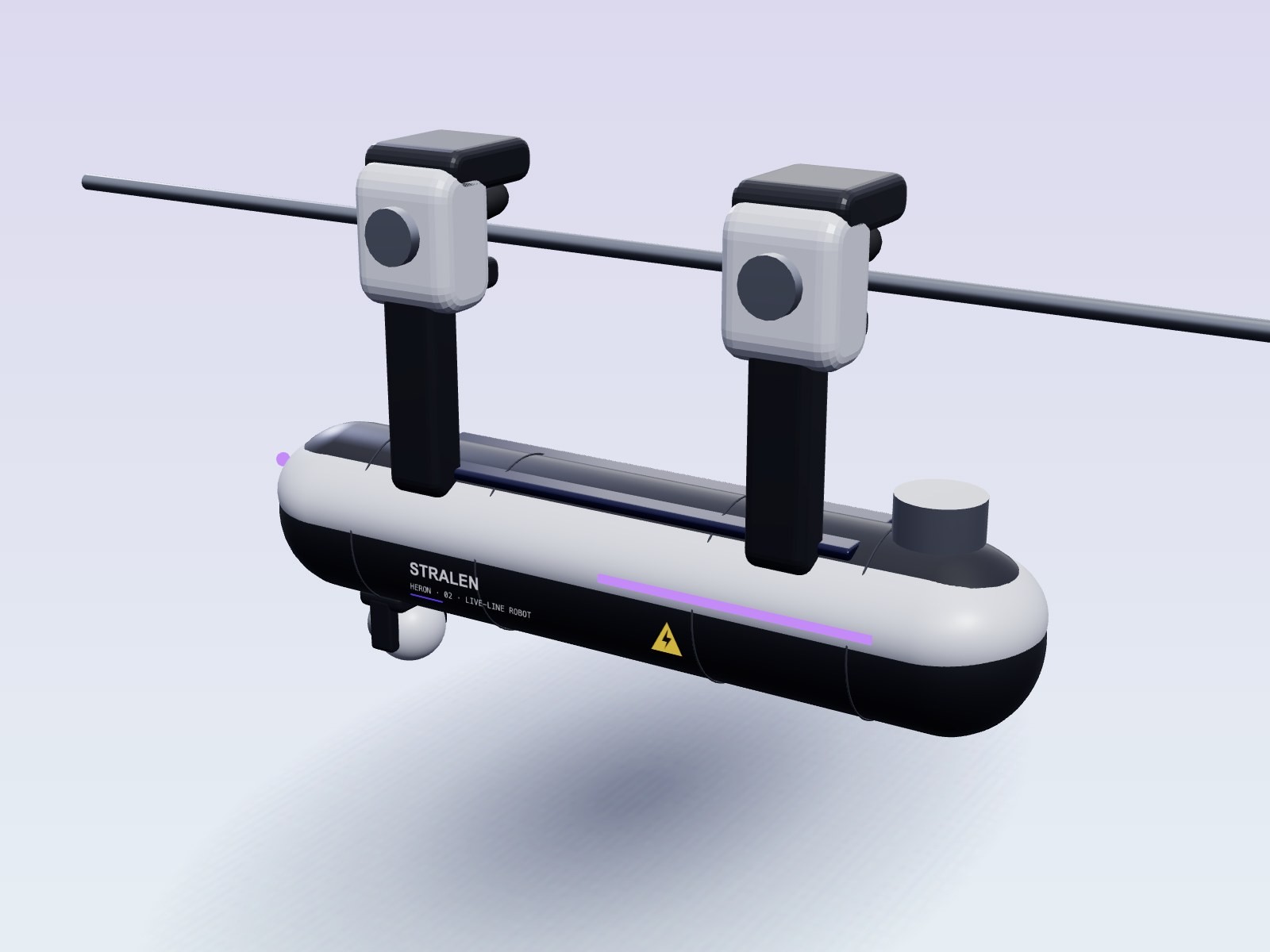
Heron hangs on an energised conductor and drives itself from tower to tower, crossing dampers and spacers on its own. It sees each span in visible, thermal, corona UV and LiDAR, and charges from the sun and the line it rides.
Speed
2.4 km/h
Time out
Indefinite (line + solar)
Weight
38 kg
Range
12 spans per night
Voltage
69 kV to 500 kV
Install
Hot-stick, 10 minutes, two people
Sensors
4K visible · radiometric thermal · corona UV · solid-state LiDAR
Priced
From $1,900 per km a year
Overview
Rides the conductor. Inspects every span, every night.
Built to live on the line
Most inspection is a snapshot: a helicopter pass once a year, a patrol after a storm. Heron is a resident. It stays on the conductor for months, rides a stretch of line every night and comes back to the same bolt, joint and tree again and again, so change shows up while it is still small.
Crossing hardware
Twin drive units open and close around dampers, spacers and suspension clamps. Heron never leaves the conductor, and it slows to a crawl at every tower so the camera can study the insulator string on the way past.
Power
An induction collector harvests a few watts from the line current, and a solar skin tops up the battery by day. In a northern winter it keeps working through six weeks of low sun.
Four ways of seeing the same span

Visible
The shattered bell, in 4K.

Thermal
The clamp, 46 degrees too hot.

Corona UV
Discharge at the broken glass.

LiDAR
The pine, 3.2 m from the wire.
The rest of the fleet


See it on your own line.
A 90-day pilot on your worst span, with a report every morning.